Posts

Showing posts with the label popular culture

'The Swing'

Image
Two recent encounters with Jean-Honoré Fragonard's The Swing (London, Wallace Collection ) in the past few days. The first in Baz Luhrmann's adaptation of The Great Gatsby : and the second when cited as an inspiration for English Touring Opera's recent production of Così fan tutte : Both serving as reminders that we currently have an impression of the engraving which Nicolas de Launay made from the painting in the 18th century: Les Hazards Heureux de l'Escarpolette [The Swing] N. de Launay after H. Fragonard [first published c.1780, this impression late 19th century] Engraving partly printed in colour, outside of frame 76 x 60cm. £220
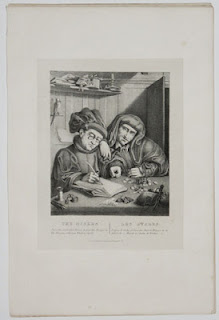
Reading Books by their Covers

Image
Images which have graced the front cover of literary works published by Penguin and Oxford University Press:  OUP used Quentin Matsys' The Misers for the cover of Five Plays by Ben Jonson . The original is lost but there are many surviving copies, including one in the Royal Collection which was the basis for our print: The Misers. From the celebrated Picture by Quintin Matsys in His Majesty's Collection Windsor Castle. Les Avares. D Apres le celibre tableau par Quintin Matsys de la galerie de sa Majeste au Chatea de Windsor. Dean & Munday Litographer's Threadneedle St. [A. Friedel.] [n.d. c.1830.] Lithograph on india, rare with large margins. 406 x 272mm. 16 x 10¾". Slight foxing bottom right Misers sat at a table logging in a book their worth. Three bulging bags of coins, tied into one, sit on the table in front, with coins spread out to the right; a bird on a perch sits behind on the wall below the shelf. After the 'Blacksmith of...

Blackadder's Print Collection

Image
Unsurprisingly, while watching the British comedy classic 'Blackadder's Christmas Carol' over Christmas, we were most interested in the prints hanging on the wall of the time-travelling malcontent: After much replaying of scenes, we found that chez Blackadder Baldrick moves out of the way just enough to allow identification of these four plates from Hogarth's classic morality series of two apprentices, 'Industry and Idleness', of which we currently have the complete set: (This is the diamond formation in which Blackadder's four prints appear). The prints, although published in 1747, around a century before Blackadder's Christmas Carol is set, say something about the master-servant relationship played out by Blackadder and Baldrick. As Paulson ( Hogarth's Graphic Works ) writes, 'The master who bought Industry and Idleness read it as a moral exemplum, while the apprentice automatically sided with Tom Idle against the mor...