Posts

Showing posts with the label narrative

The Times of Day

Image
Sets of prints showing the times of day: morning, noon, evening and night. This 17th century set was published in Antwerp, then one of the major print-publishing centres. It focuses on a woman's activities throughout the day: [Four Times Of Day]  Mart. vanden Enden execudit Antwerpiae. Set of four engravings. 203 x 292mm. The composition depicts female figures in contemporary dress engaged in 17th century occupations and pastimes. Martin van den Enden. A publisher and printmaker from Antuwerp, flourishing 1630 - 1645. Most associated with works after Van Dyck. [Ref: 7046]  £950 Unlike the scenes in van der Enden's set, which maintain a compositional conformity (the woman is stood in the middle of each scene), a set by Bonnart shows more diversity. In this set midday is represented by eating, and evening by sleeping: [Times of Day] Le Matin [&] Le Midy. [&] La pres disner. [&] Le ...
Reading Books by their Covers

Image
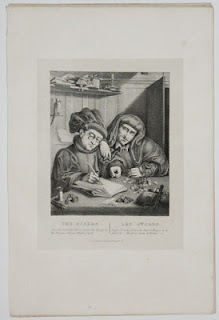
Images which have graced the front cover of literary works published by Penguin and Oxford University Press:  OUP used Quentin Matsys' The Misers for the cover of Five Plays by Ben Jonson . The original is lost but there are many surviving copies, including one in the Royal Collection which was the basis for our print: The Misers. From the celebrated Picture by Quintin Matsys in His Majesty's Collection Windsor Castle. Les Avares. D Apres le celibre tableau par Quintin Matsys de la galerie de sa Majeste au Chatea de Windsor. Dean & Munday Litographer's Threadneedle St. [A. Friedel.] [n.d. c.1830.] Lithograph on india, rare with large margins. 406 x 272mm. 16 x 10¾". Slight foxing bottom right Misers sat at a table logging in a book their worth. Three bulging bags of coins, tied into one, sit on the table in front, with coins spread out to the right; a bird on a perch sits behind on the wall below the shelf. After the 'Blacksmith of...

Telling Stories

Image
The idea of pictures being composed in series has been employed by many artists and printmakers, either to illustrate existing narratives or to create new ones. One of the best-known artists to employ this device was Hogarth, whose 'modern moral subjects' such as the Harlot's Progress , Industry and Idleness and Four Stages of Cruelty track the progress (always an ambiguous word in Hogarth's usage) of characters through multiple stages. But while Hogarth was an innovator in many ways, his series also formed part of a well-established tradition of representing narratives in sequence. Many artists and printmakers were involved in elaborate projects to illustrate literary works , as Hogarth himself had been. Sometimes these were small sets, such as these atmospheric illustrations to Tasso's Jerusalem Delivered (to see more images from each series click on the links): Six scenes from 'Jerusalem Delivered' [Various engravers, including Edward Rooker an...